
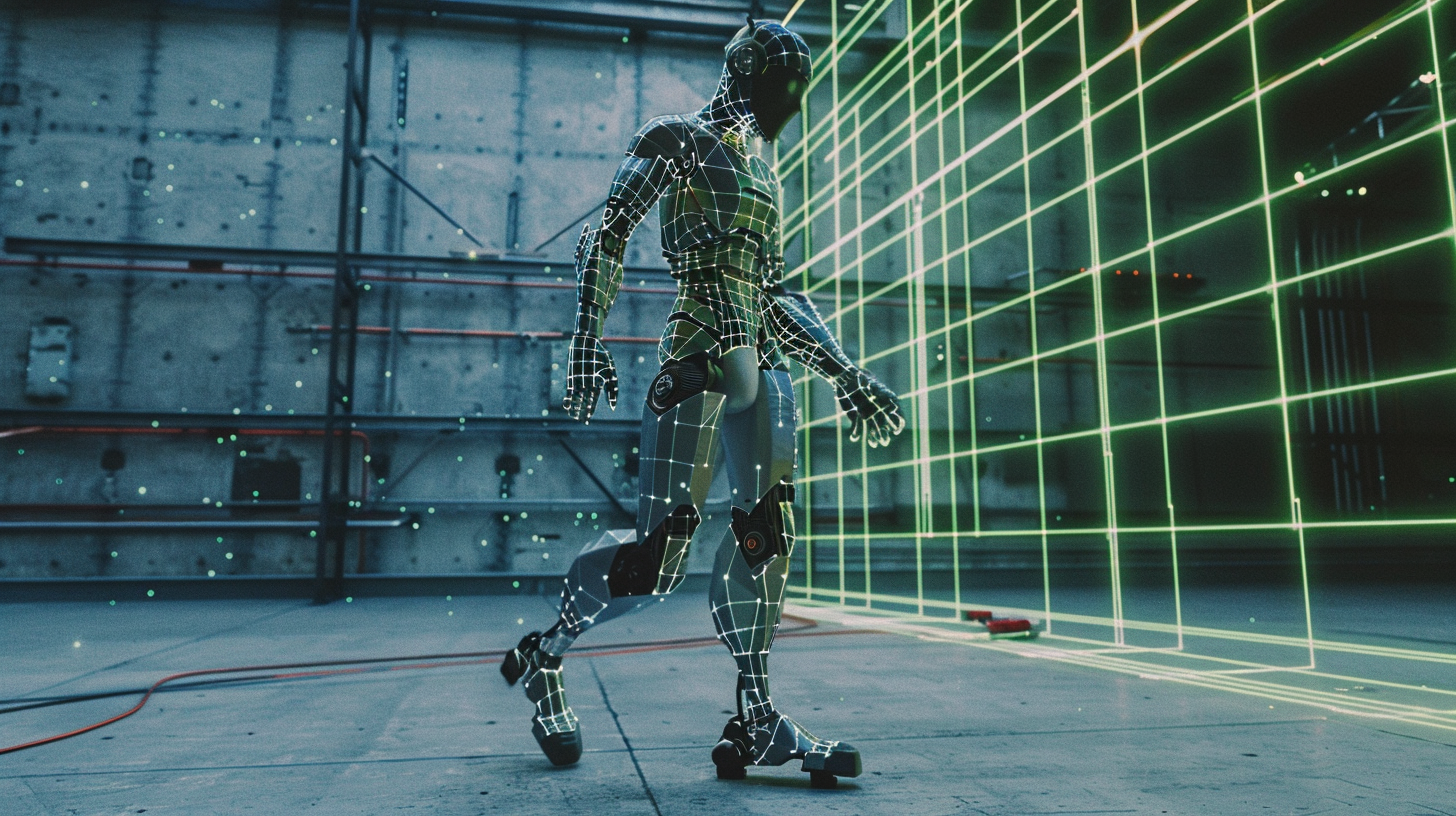
The Sci-Fi Concept
For decades, science fiction gave us autonomous mechanoids that learned to navigate the world via spontaneous consciousness or rapid software patches. From the nimble security droids of Star Wars to the hyper-coordinated humanoids of I, Robot, cinematic machines stepped into the physical world fully formed, possessing an innate, flawless mastery over gravity, terrain, and balance.
The Non-Fiction Reality
In the real world, the development of physical robotics has spent years choked by an agonizing bottleneck: the physical data crisis. For a humanoid or quadruped robot to learn how to recover from a trip or cross a gravel pathway, it had to run through thousands of hours of destructive trial-and-error in real laboratories. Progress was measured in broken actuators, warped chassis, and millions of dollars in mechanical wear.
That framework is being dismantled by the rise of generative video. Rather than learning through physical failure, machines are learning to move by watching synthetic simulations of reality.
The core infrastructure driving this transition is the emergence of open-weight World Foundation Models (WFMs) and specialized physical AI platforms. Chief among them is the NVIDIA Cosmos 3 platform, an architecture built specifically to break the data bottleneck by acting as an omnimodal world simulator. Powered by a unified mixture-of-transformers architecture, Cosmos 3 processes text, imagery, and audio to predict and stream hyper-realistic, physics-grounded video trajectories at up to 30 frames per second.
[TRADITIONAL ROBOT TRAINING] ──> Physical Lab ──> Hardware Wear ──> Months of Execution
[GENERATIVE WFM TRAINING]   ──> Cosmos 3   ──> Synthetic Video ──> Days of Calculation
Code language: CSS (css)
Instead of recording a physical robotic arm failing to grasp a glass tumbler ten thousand times, developer alliances—including groups like Skild AI and Agile Robots—are utilizing these models to generate infinite hours of synthetic sensor data. The robot’s policy model is exposed to custom camera layouts and varying environmental terrains within a digital sandbox, compressing months of hardware validation into mere days of high-compute simulation.
The Friction Point: The Danger of Hallucinated Physics
When a machine trains entirely inside a generative video sandbox, it becomes hyper-optimized for the rules of that specific environment. However, neural world models operate on probabilistic prediction, not absolute mathematics. If a WFM introduces subtle algorithmic hallucinations into its rendering loop—such as slightly miscalculating the fluid dynamics of a spill or the friction coefficient of a slick surface—the robot inherits a warped understanding of reality. When deployed into a non-negotiable physical environment, this gap between hallucinated physics and objective reality risks causing catastrophic mechanical or structural failure.
The Simulation-to-Real (Sim2Real) Tectonic Split
This shift alters the geopolitical and corporate landscape of robotics development. Historically, the companies with the largest physical testing facilities held a monopoly on robotics capabilities. With world foundation models, the advantage tilts entirely toward the organizations controlling the highest concentrations of compute power.
By processing vast corpuses of specialized driving and environmental footage, generative world engines have internalized a generalized intuition of physical dynamics. They understand how liquids pour, how rigid bodies collide, and how shadows shift with motion. This creates an end-to-end synthetic pipeline where robots can be pre-trained on “imagined” futures before their logic models are ever flashed onto physical silicon.
Yet, this reliance on synthetic data introduces a deeper systemic vulnerability. If the dataset used to train the underlying world model lacks sufficient representation of “long-tail” scenarios—rare anomalies like a sudden structural collapse or extreme weather conditions—the generated sandboxes will remain blind to those events.
A machine may achieve flawless operational efficiency inside a perfectly rendered digital warehouse, yet fail completely when confronted with an unmapped, real-world structural anomaly. By relying on generative video to solve the data crisis, we are building autonomous systems whose safety limits are bound strictly by the imagination of the networks that trained them.
The View From Orbit
From our satellite perspective, the deployment of platforms like Cosmos 3 signifies a profound structural inversion. Humanity is no longer engineering machines to adapt to the physical earth through raw experience. Instead, we are generating automated, synthetic layers of reality to serve as artificial nurseries for a new generation of physical intelligence.
As these world simulators become increasingly complex, the boundary between physical testing and algorithmic hallucination dissolves. The satellites are observing a world where the physical architecture of our future infrastructure is being shaped, tested, and validated within the unmapped, probabilistic interior of a neural network.
To see these world foundation models functioning in a real-world developmental ecosystem, you can watch NVIDIA’s Official Cosmos Launch Presentation. This broadcast details how developers tie synthetic video generation directly to physical AI and embodied robotic systems.