
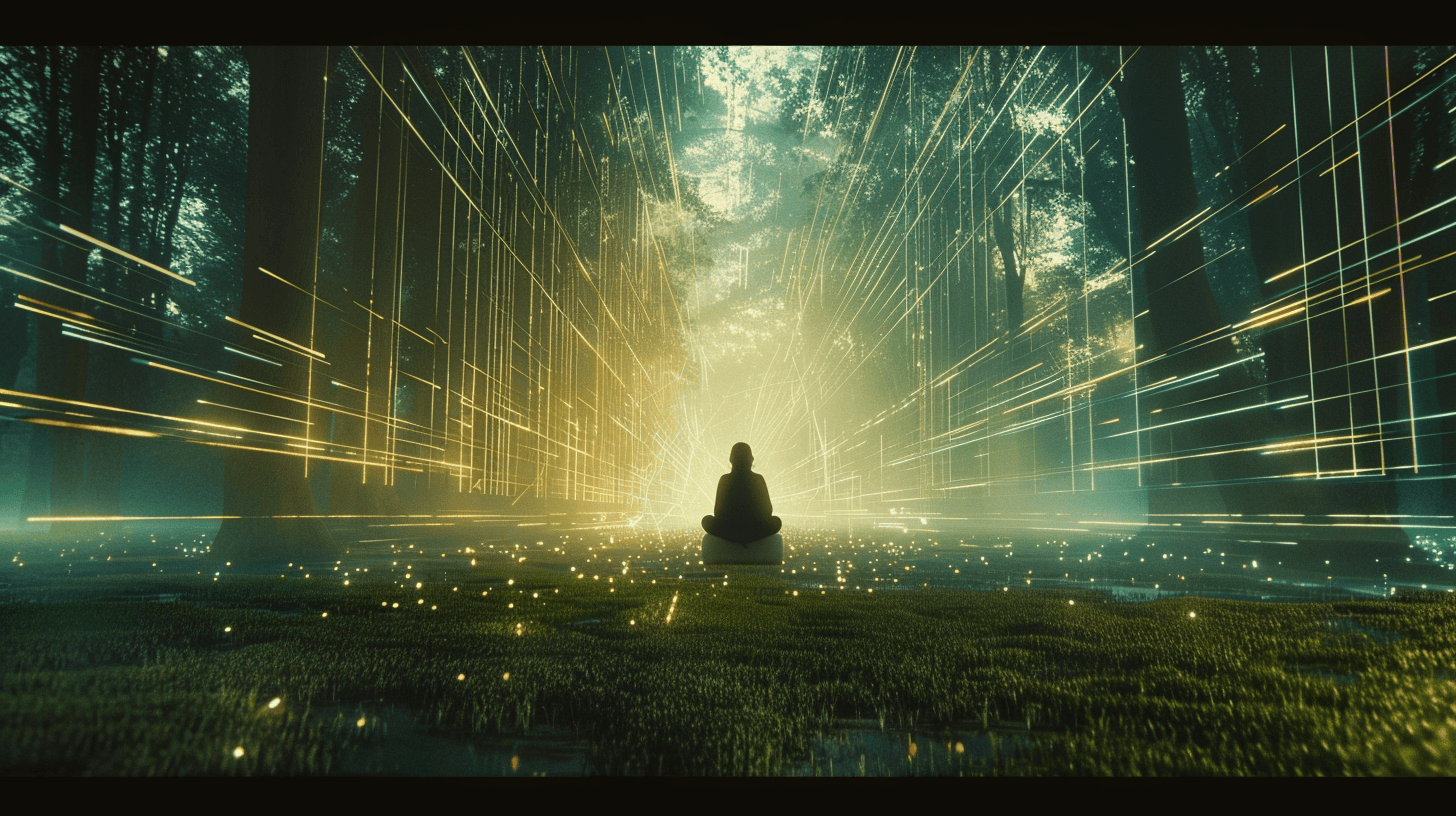
The Sci-Fi Concept
For decades, science fiction warned us of the ultimate escapist trap: virtual environments so perfectly tailored to the human subconscious that reality pale by comparison. From the highly addictive, neural-reactive holodecks of Star Trek to the personalized, choice-driven data streams in Caprica, we imagined a future where entertainment would evolve from a passive broadcast into a shape-shifting, responsive psychological mirror.
The Non-Fiction Reality
That boundary has completely dissolved. We are no longer discussing speculative fiction; we are documenting an active infrastructure race. The transition from handcrafted, multiplayer game servers to real-time generative worlds has officially begun.
The most telling evidence of this shift lies in the massive architectural pivot occurring at the corporate core of user-generated entertainment. Massive spatial platforms are quietly executing a talent and technology sweep designed to phase out traditional asset loading entirely. Recent technical acquisitions—including the absorption of real-time generative world engine pioneer Dynamics Lab, alongside generative video labs like Morpheus AI and Lucid AI—have been consolidated into an ambitious infrastructure initiative known as Roblox Reality.
[BROADCAST ENTERTAINMENT]  ──> One Master Render ──> Public Distributed Feed ──> Shared Culture
[PROCEDURAL SIMULATION]   ──> Live User Inputs    ──> Algorithmic World Engine ──> Hyper-Isolated Reality
Code language: CSS (css)
Rather than forcing developers to build static maps with traditional 3D polygon geometry, this hybrid architecture fuses a deterministic game engine with a real-time, autoregressive video foundation model running on edge GPU data centers. Technologies like “Self Forcing”—which converts sluggish, offline AI video models into responsive, interactive streams—allow these systems to process a player’s immediate text, image, or behavioral inputs and synthesize fully responsive, 4K photorealistic environments at 60 Hz. The machine no longer retrieves a pre-built world from a server file; it continuously dreams the landscape into existence around the user.
The Friction Point: The Liquidation of the Collective Baseline
When an interactive simulation shifts from a static map that thousands of players experience simultaneously to a hyper-tailored world model generated dynamically on the fly, entertainment undergoes an algorithmic drift. If a generative world engine constructs environments, physics, and narrative arcs mapped exclusively to the microscopic psychological triggers, historical telemetry, and behavioral hooks of a single user, we lose the concept of a shared digital space. By isolating the individual within a personalized, fluid reality machine, we structurally dismantle the collective cultural baseline required for societal consensus.
The Monopolization of the Mind’s Eye
This technical leap completely rewrites the monetization of human attention. In traditional entertainment media, developers and directors create an artistic work with fixed boundaries, exposing their biases and narratives to a critical public sphere. The viewer retains an analytical distance; they can discuss, critique, or reject the shared object.
Procedural world models erase that distance entirely. When the environment itself is a fluctuating feedback loop responding to live biometric or input data, the simulation behaves like an active psychological mirror. It can automatically tune its atmospheric lighting, spatial geometry, and environmental pacing to maximize user retention, exploit vulnerability, or smooth over cognitive dissonance.
The political and philosophical fallout of this systemic isolation is unprecedented. If two individuals spend their formative digital hours navigating realities that are structurally, visually, and logically distinct—generated on opposite ends of a personalized algorithmic matrix—the capacity for a shared public discourse collapses. We are not just dealing with the fragmentation of news feeds or echo chambers on a flat screen; we are looking at the fragmentation of navigable space itself.
The View From Orbit
From our satellite observatory, the deployment of real-time generative world architectures marks the final stage of digital enclosure. Humanity is transitioning from an internet of shared infrastructure into an unmapped archipelago of hyper-isolated, synthetic dimensions.
As these world engines scale, the traditional public square is replaced by a trillion private realities, each engineered to keep its lone occupant perfectly contained within a seamless, hallucinated stream. The satellites are watching a civilization undergoing a mass migration inward—where the architecture of our collective future is being traded for an infinite, single-user dream.
To see how these technical foundations are being laid out right now by industry leadership, you can watch Roblox CEO David Baszucki discuss the intersection of AI, physics, and the Roblox Reality vision. This briefing breaks down the long-term move away from traditional rendering software and toward immersive, generative world models.