
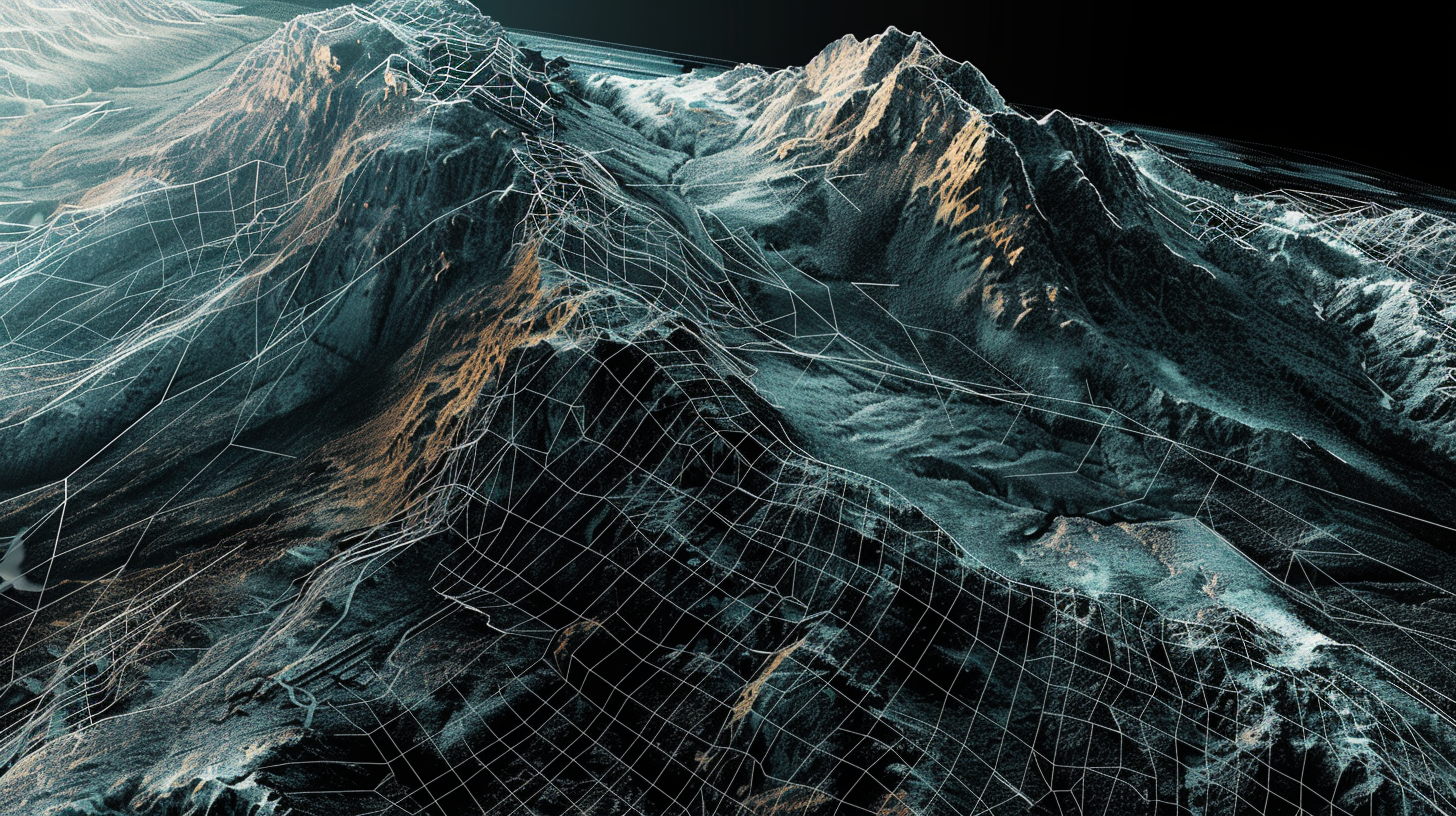
The Sci-Fi Concept
For generations of science fiction writers, the digital universe was fundamentally geometric. From the glowing grids of Tron to the loading programs of The Matrix, we imagined simulated reality as an act of hyper-complex drafting—infinite frameworks of vector lines, textures, and ray-traced light bounces built piece by piece by digital architects.
The Non-Fiction Reality
That geometric future is dead before it could even finish scaling. In a massive paradigm shift, the technology industry is abandoning explicit 3D math in favor of predictive hallucination.
We have officially moved past the era where computers calculate space using polygon meshes, lighting maps, and rigid physics code. Instead, we have entered the dawn of the Large World Model (LWM) and Spatial Intelligence.
Systems like Google DeepMind’s Genie 3 (now accessible globally via Project Genie) and World Labs’ newly launched platform, Marble, are rendering persistent, interactive, 3D environments on the fly. Operating at a fluid 24 frames per second at 720p resolution, these engines don’t build space; they predict it. By processing text inputs, static images, or even Google Street View coordinates, these models generate navigable first-person environments purely out of neural weights.
From Math to Memory: How Space Became Code
To understand how radical this shift is, one must look at the legacy architecture of virtual creation. For decades, if a developer wanted to build a room in Unreal Engine or Unity, a human asset creator had to define the hard limits of reality:
- Construct a wireframe mesh out of vertices and polygons.
- Wrap that mesh in a texture file to simulate a surface.
- Code an explicit physics script determining how a ball bounces off the floor or how light refracts through a window.
World models bypass the math completely. Dr. Fei-Fei Li, co-founder of World Labs, frames this evolution as the leap from “word prediction to world prediction.” While Large Language Models ($LLMs$) predict the next logical token in a sentence, an LWM predicts the next logical point in 3D space.
[LEGACY CGI ENGINE] ──────> Vertices ──> Polygons ──> Physics Code ──> Explicit Render
[NEURAL WORLD MODEL] ────> Text/Image Prompt ──> Spatial Intelligence ──> Predicted Reality
When you walk through a doorway in Project Genie, the AI doesn’t calculate the door’s dimensions or look up a physics file. It simply understands—via spatial intelligence trained on millions of hours of real-world video—how geometry, light, and perspective ought to behave when a camera shifts. It streams 3D Gaussian Splatting and Level-of-Detail systems straight to a browser, fabricating space out of probability.
The Friction Point: The Liquidation of the Asset Economy
If a neural network can generate a photorealistic, fully interactive, and persistent city block from a text prompt in seconds, the multi-billion-dollar economy of digital asset creators faces structural liquidation. The transition from explicit geometric coding to “vibe coding” virtual spaces removes the need for traditional 3D pipelines, threatening to turn the meticulous craft of environment art into a historical footnote.
The Rise of “Vibe Coding” Reality
The economic fallout of this shift will ripple far beyond the VFX houses of Hollywood or the studios of AAA game developers. We are looking at a fundamental democratization—and subsequent devaluation—of spatial creation.
When spatial environments become a horizontal commodity, the barrier to entry drops to zero. A director no longer needs a team of technical directors to build an LED volume virtual background; an indie game designer no longer needs an army of 3D modelers to populate an open world. They need a prompt, a seed image, and an orientation vector.
But this “vibe coding” approach to reality introduces a profound systemic vulnerability: the loss of granular control.
Traditional CGI is rigid, but it is flawless in its mathematical precision. If a structural engineer tests a bridge design inside a legacy CAD simulator, the physics are mathematically verifiable. When a robot trains inside an AI-generated World Model, it is training inside a simulation that can hallucinate.
If a neural world engine subtly miscalculates gravity, fluid dynamics, or surface friction because of a gap in its training data, the autonomous systems learning inside that sandbox will inherit those flaws. A humanoid robot that masters balance in a hallucinated environment faces mechanical catastrophe the moment its physical foot hits unyielding, non-negotiable real-world concrete.
The View From Orbit
From our high-altitude perspective, the deployment of Large World Models looks less like a creative tool and more like a form of digital terraforming. We are rapidly approaching the event horizon of Single-User Procedural Realities—virtual spaces generated in real-time, tailored precisely to the behavioral hooks of a single observer.
When the wireframe dies, our shared baseline of digital reality goes with it. The internet will no longer be a network of shared pages and static games that we all look at together; it will become an infinite collection of personalized, hallucinated dimensions. The satellites are watching a world where human beings are slowly retreating into custom-built, neurally rendered universes—leaving the physical substrate behind.